The development prospects of the domestic and foreign small and medium-sized engineering tire market are extremely broad. Under the adjustment of national policies, domestic mines have gradually recovered since 2015, and the demand for engineering tires has increased. At the same time, under the influence of the "the Belt and Road" policy, regions and countries with rich mine resources abroad are increasingly demanding for engineering tires. These places include Africa, as well as Pakistan, Vietnam, Myanmar, Mongolia, Russia, and others. With the impact of changes in the international market economy and the transformation of market products, the operating speed of vehicles is getting faster and the transportation distance is getting longer, and diagonal tire products can no longer meet the normal use. The era of excessive profits in the mining industry is gone forever, and better cost-effectiveness has become a necessity for end users. The situation where international tire giants dominate the engineering tire market is slowly undergoing a transformation.
Tires, as one of the three major consumables in mines, are receiving increasing attention in terms of cost and usage. In the transportation cost of mines, the cost of tires ranks second only to maintenance costs, accounting for approximately 20% to 30%. The cost of tires also increases with the increase of Deadweight tonnage of vehicles. Both Heidaigou and Halwusu open-pit mines use large heavy-duty trucks, among which the Halwusu open-pit mine's 59/80R63 tire is the world's largest engineering tire. Engineering tires are an important component of mining vehicles, with an outer diameter of over 4 meters, making them expensive per tire. The correct use of tires can extend their service life and is also of great significance for ensuring driving safety. The road conditions and environment in which engineering tires are used are relatively harsh, so special attention needs to be paid to the use and maintenance of engineering tires. The service life of engineering tires varies depending on the vehicle's load, speed, and on-site road conditions.
Taking 12.00-20-18PR mining tires as an example to explain, traditional mining tires should control their air pressure at a reasonable position based on local bearing tonnage and road conditions. Excessive air pressure can cause increased tire wear, while too small pressure can cause sidewall folding or grinding. So it is important to adjust the reasonable air pressure, as the operation is cumbersome and requires too much experience from the user.
Compared with ordinary tires, mining tires have thickened sidewalls on the top and sides of the tires, with an extra layer of special speed cord fabric added at these positions. Different materials are used at different positions, which is why mining tires exhibit better load-bearing and puncture resistance than ordinary tires. Even so, the service life of mining tires is still only a few months.
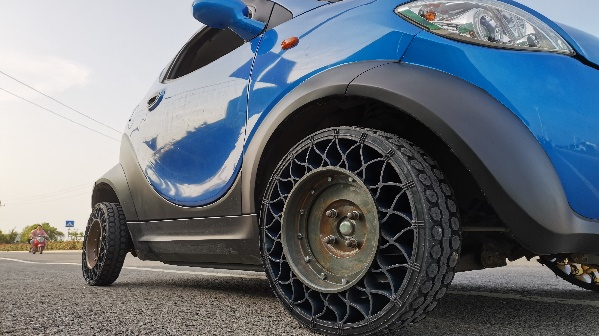
The emergence of non pneumatic tires perfectly solves this problem. The tread of non pneumatic tires is a combination of shear bands and patterns, and the surface is resistant to puncture without fear of tire burst risk. The side of non pneumatic tires is a polyurethane spoke structure. Our company's developed spokes are designed for mining use and have the following characteristics: 1. high elasticity and high toughness; 2. The spokes do not expand after being cut, resulting in a long service life; 3. 50% of the damaged spokes still have load-bearing capacity and higher safety.
Overall, the service life of non pneumatic tires is 2-3 times that of traditional mining tires. Not only does it improve the work efficiency of the vehicle, but it also ensures its safety performance.